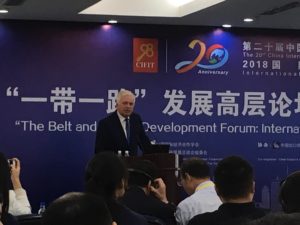
The Slovakian Ambassador to Beijing, Dušan Bella, speaking about Europe’s integration into the Belt and Road Initiative.
Xiamen – On September 9th, FAO Global CEO Brandon Hughes, attended an all-day forum focused on the Belt & Road Initiative (BRI) from both a Chinese business perspective and government. This forum was part of the 20th China International Fair for Investment and Trade held in Xiamen City, Fujian province, China. The event was attended by provincial and city leaders from Xiamen and Fujian, as well the Ambassador to Beijing from Slovakia, the U.S. State Department, and an emissary from Egypt.
The Forum’s specific topics were:
- International Production Capacity Cooperation
- Investment Cooperation between supply chain finance and the China Railway express
The Major Takeaways:
Success Means Community Buy-In
The majority of government officials touted the success and vision of Chinese President Xi Jinping and the global benefits this initiative will achieve. However, the speakers were quick to acknowledge recent set-backs in large projects, such as the roll-back of BRI projects by the President of Malaysia, lack of usage of local labor, lack of technology and skills transfer, and the fear of the receiving country being laden in heavy debt. Government officials contended that in order for the BRI to prevail, Chinese businesses and policy makers should pursue projects that are community minded.
The Vision doesn’t match the ground conditions
Another area that was highlighted were the realities of conducting international trade and development across multiple countries that all had different tax and export controls. Issues concerning RMB remittance, export paperwork issues, and even on-ground logistics all were challenges facing the vision that is the BRI. Numerous examples of cancelled BRI projects due to lack of community support and concerns over holding Chinese debt were addressed (such as recent cancellations from Malaysia and concerns over projects in Sri Lanka and Myanmar). Analyst Comment: FAO Global associates traveled to Myanmar and Thailand at the start of 2018 (see Myanmar Impressions here) and noticed a conspicuous lack of BRI interest outsides of a few projects.
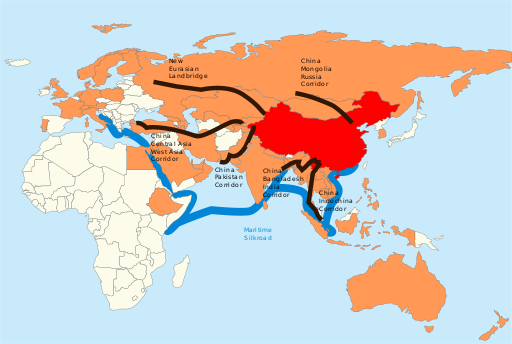
Chinese expansive Belt and Road Initiative is multi-continent infrastructure and trade initiative that detailed in it’s concept but loosely defined for projects on the ground. The BRI is also known as the One Belt One Road Initiative (OBOR) but BRI is now the most used.
Understanding the Risk
The speakers from the business community highlighted the difficulties in both financing and mitigating risk to financing. One problem facing Small and Medium Size Enterprises (SMEs) is financing projects and protecting against loss in transit. Speakers highlighted that international banks will only us U.S. dollars (USD) for transactions and won’t remit into RMB. One of the speakers suggested that this was due to international banks being wary of U.S. There were only a few insurance companies who presented at the investment forum focused around the BRI. However, there was a surprising lack of specifics on display relating to the Belt and Road Initiative, even in Pavilion Areas allocated exclusively to BRI companies and cities involved. Nearly 100% of the displays in these pavillions had nothing to do with the BRI
FAO GLOBAL ASSESSMENT
The breakdown between high-level vision and on-ground execution is not new. The sheer amount of logistical and legal hurdles in new countries coupled with divergent cultures means complicated plans for local Chinese companies. While there are considerable opportunities and support from the Chinese government, there doesn’t seem to be a single narrative on how execution is supposed to happen. The Center for International and Security Studies (CSIS) recently highlighted that in the 173 identified projects that fell under the BRI, many fall into such different categories and geographic locations that what constitutes an official BRI project is unclear. That same distortion is seen on the ground as observed by the various businessmen who presented. ANALYST COMMENT: FAO Global saw the same breakdown between BRI statements and on-ground realities when it conducted a country exploration mission to Myanmar January 2018.
Analyst Bio
Brandon Hughes – FAO Global Founder/CEO
Brandon Hughes, the Founder of FAO Global developed the company with a few primary goals in mind. Promote global engagement through business intelligence & diplomacy, provide a platform for overseas professionals with unique experiences to grow, and promote mutually beneficial solutions for private, non-profit, and government entities. His own experiences have taken him to foreign areas as diverse as China, Kosovo, Afghanistan, and Myanmar.
He is a former Active Duty Army Officer & combat veteran who has built a career on developing opportunities and relationships through actionable on-ground research, government relations, and strategic analysis. Brandon has completed internships for the prestigous Carnegie Endowments’ Carnegie-Tsinghua Center for Global Policy in Beijing, and Asia Society of Northern California where he learned high-level diplomacy first hand. Having trained at some of the world’s top institutions such as Tsinghua University (清华大学) & Johns Hopkins University, Brandon applies his passion for excellence into the FAO Global culture. His unique alumni network in China includes the current and former President of China, Xi Jinping & Hu Jintao respectfully.
Business Missions and Exploration are an integral part of our consulting and analysis services. Only by understanding the “ground truth” can we advise on realistic strategies suitable to the local market conditions.
About FAO Global Business Missions
In order to promote cross-border understanding, FAO Global Founder & CEO Brandon Hughes, offers accompanied business missions to China and Southeast Asia. These missions are intended to build your company’s professional network and provide an on-ground understanding of local market conditions and atmospherics. These business missions can be coordinated in conjunction with conferences, exhibitions, or conventions. SEE MORE ABOUT OUR BUSINESS MISSIONS HERE
Headquartered in Washington, DC with Affiliates in Asia
Our Analysts, Associates, Consultants, and Interns all possess extensive experience in a foreign country and a foreign language capability. Our talent pool includes graduates from the elite Tsinghua University in Beijing, Georgetown University, George Washington University, UC Berkeley, and University of South Carolina. Being based in the Washington, DC Metro Area provides our team the advantage to build relationships with policy makers, foreign diplomats, business leaders, and non-profit groups providing a holistic view of global policy and the impacts to the business community. In addition to being based in the Washington, DC area, we retain the input and advice from affiliates located in China. This allows us to maintain on-ground awareness of changing business and political environment conditions and facilitate client projects between the two countries and the greater Asia continent.
Before you go abroad, get connected with our custom Intelligence Briefs are reviewed and guided by a Senior Analyst before publication.